Stainless Steel High-Temperature Fan
Product Description
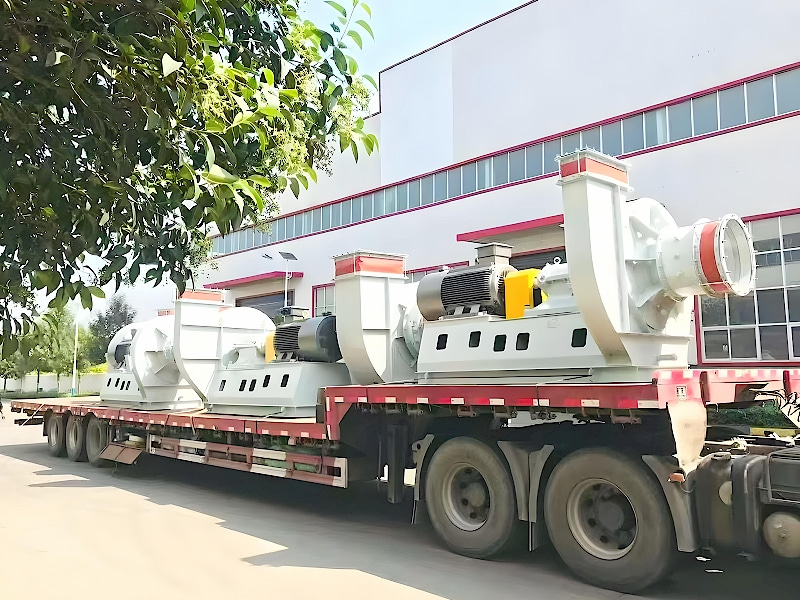
The stainless steel high-temperature fan is a special industrial fan designed specifically for high-temperature operating environments. The entire fan is made of high-temperature resistant stainless steel and equipped with a high-temperature dedicated motor and heat dissipation structure, capable of stably conveying gases at temperatures from 100℃ to 900℃ or even higher.
Applications
Metallurgical Industry: Blast furnace ventilation, hot blast stove, sintering machine ventilation, dry quenching coke circulation
Chemical and Petrochemical Industry: High-temperature reactor exhaust, incinerator ventilation, corrosive waste gas conveying
Building Materials and Glass Industry: Ceramic kilns, glass melting furnaces, cement kiln cooling/exhaust
Heat Treatment and Drying: Heat treatment furnaces, annealing furnaces, high-temperature drying for food/pharmaceuticals, hot air circulation
Environmental Protection Industry: Waste incineration, hazardous waste treatment, high-temperature desulfurization and denitrification
Power Industry: Boiler induced draft, power plant ventilation systems
FAQ
Q1: What is the core difference between a stainless steel high-temperature fan and an ordinary fan?
A: The two differ fundamentally in terms of material, temperature resistance, structure, and motor. The stainless steel high-temperature fan body is made of heat-resistant stainless steel such as 304/316L/310S, and can operate stably for extended periods at temperatures ranging from 100-600℃. It is equipped with a thermal expansion compensation structure, a heat insulation and cooling system, and an H-class high-temperature dedicated motor. Ordinary fans, on the other hand, are mainly made of ordinary carbon steel or galvanized sheet, and are only suitable for normal temperature ventilation environments ≤50℃, lacking specialized high-temperature protection design. Furthermore, stainless steel possesses excellent corrosion resistance, resisting the erosion of corrosive gases containing sulfur and chlorine.
Q2: How to select the appropriate stainless steel material based on the operating temperature?
| Temperature |
Material |
| 400℃ |
304 Stainless steel |
| 400℃-500℃ |
316 Stainless steel |
| 500℃-800℃ |
310S Stainless steel |
| 800℃-950℃ |
310S Stainless steel |
Q3: What are the common faults of stainless steel high-temperature fans? How to solve them?
A: Common faults and solutions are as follows:
① Severe bearing housing vibration – Possible causes include misalignment of the fan shaft and motor shaft, friction between the casing or air inlet and the impeller, insufficient foundation rigidity, impeller deformation, or loose rivets. Solutions: Realign concentricity, adjust impeller clearance, reinforce the foundation base, repair or replace the impeller.
② Bearing overheating or oil leakage – Possible causes include charring of the bearing housing seals (above 350℃), insufficient or deteriorated lubricating oil. Solutions: Replace with high-temperature resistant graphite or metal bellows seals, and regularly check and replenish high-temperature grease.
③ Motor overheating or burnout – Possible causes include insufficient motor power, cooling system failure, or insufficient insulation class. Solutions: Under high-temperature conditions, use an H-class insulated motor and ensure the water-cooling or air-cooling system is functioning properly.
④ Insufficient airflow or reduced efficiency – Possible causes include blocked air inlet, fan reversal, and abnormal voltage. Solution: Regularly clean the air inlet and duct dust, and check the power supply phase sequence and voltage.


