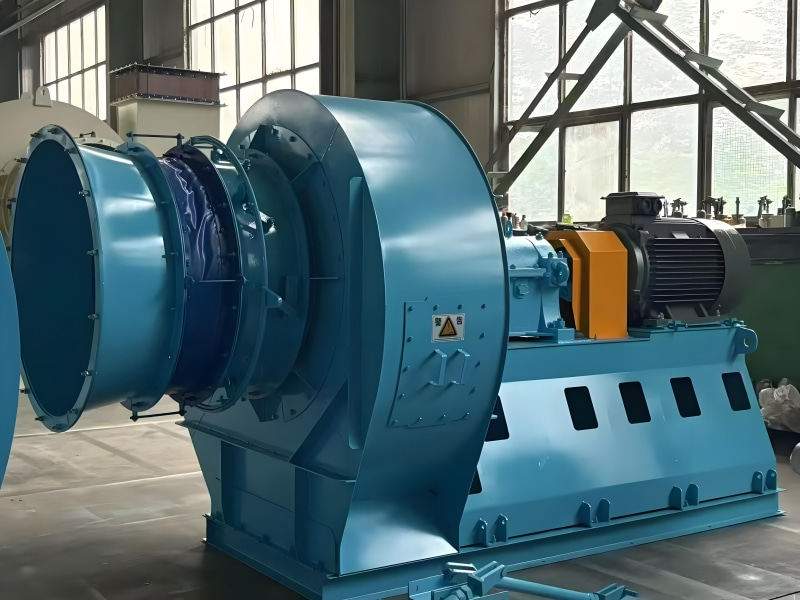
Stainless Steel Fans for Food Factories
## I. Product Overview and Applications
Stainless steel fans are ventilation devices made primarily of stainless steel (commonly 304, 316L, etc.). They offer excellent corrosion resistance, high-temperature resistance, and high strength, making them widely used in industries such as chemical, food, and pharmaceuticals where cleanliness or corrosion resistance is critical. In the food processing industry, stainless steel fans perform key tasks including workshop ventilation and air exchange, drying and dehumidification, cleanroom air circulation, raw material vacuum conveying, and explosion-proof ventilation. They are essential equipment for ensuring food safety and improving the production environment.
Food factory environments are characterized by high humidity, high temperatures, grease, and salt mist. Ordinary carbon steel fans are highly susceptible to rust and corrosion, which not only shortens equipment life but also risks contaminating food products with rust particles. Stainless steel fans, with their superior corrosion resistance and easy-to-clean properties, effectively resist corrosive media such as moisture, vinegar, soy sauce fermentation gases, etc., while meeting international food hygiene standards like GMP and HACCP.
Typical applications include: ventilation and dehumidification in food processing workshops, hot air circulation in drying rooms, positive pressure air supply in clean filling areas, dust removal and explosion-proof ventilation in flour mills, oil fume extraction in frying lines, cooling and drying in bakeries, and vacuum conveying of raw materials.
## II. Product Features
### 1. Excellent Corrosion Resistance
The core advantage of stainless steel fans is their outstanding corrosion resistance. Grade 304 stainless steel offers better corrosion resistance than ordinary carbon steel, suitable for humid, mildly acidic or alkaline gas environments. Grade 316L stainless steel, with added molybdenum, provides even stronger resistance to chloride corrosion, making it ideal for high-salt or strong acid/alkali conditions. Compared to ordinary carbon steel fans (which require frequent repainting and rust removal), stainless steel fans need virtually no rust prevention maintenance. In corrosive conditions, their service life can reach 5–8 years, 2–3 times that of carbon steel fans.
### 2. Superior High-Temperature Resistance
Stainless steel can withstand temperatures above 300°C (depending on the grade), making it suitable for drying ovens, boiler ventilation, kitchen exhaust, etc. Ordinary carbon steel fans typically have a temperature limit of ≤200°C and are prone to deformation at high temperatures.
### 3. Food-Grade Hygienic Design
The main contact parts are made of food-grade stainless steel, with a special polished surface (mirror finish up to Ra≤0.8μm) that is smooth and free of dead corners, effectively preventing microbial growth and contaminant accumulation. High-end models feature seamless, threadless sanitary connections that meet FDA, GMP, and other international hygiene standards, and support CIP (Clean-in-Place) and SIP (Sterilize-in-Place). The smooth surface resists dust accumulation, fully meeting hygiene standards for the food and pharmaceutical industries.
### 4. High Efficiency, Low Noise, and Stable Operation
The impellers are often designed with backward-curved or forward-curved blades, dynamically balanced for low vibration and low noise. Noise can be further reduced by adding silencers. The motor protection rating is at least IP54, with some models reaching IP66, ensuring long-term stable operation in high-humidity, dusty environments. The high strength of stainless steel provides better impact resistance than aluminum or plastic fans, making it suitable for conveying gases containing dust or particulates.
### 5. Flexible Installation Options
Both horizontal and vertical installation are supported, allowing flexible adaptation to duct layouts. Some models come with flanged connections for direct attachment to stainless steel ducting (e.g., food-grade piping systems). The discharge angle can be adjusted in multiple directions to suit different on-site installation requirements.
## III. Frequently Asked Questions (FAQ)
**Q1: Why should a food factory choose a stainless steel fan instead of an ordinary carbon steel fan?**
A: Food factory environments typically feature high humidity, high temperatures, and grease. Ordinary carbon steel fans are prone to rust and corrosion, which shortens equipment life and risks contaminating food with rust particles. Stainless steel fans offer excellent corrosion resistance against moisture, acidic gases, disinfectants, etc. They also have a smooth, easy-to-clean surface that meets food hygiene standards. Although the initial purchase cost of a stainless steel fan is 2–3 times that of a carbon steel fan, in corrosive conditions carbon steel fans often last less than one year, while stainless steel fans can last 5–8 years, offering better long-term value.
**Q2: How to choose between 304 and 316L stainless steel?**
A: 304 stainless steel is suitable for humid, mildly acidic or alkaline gas environments (e.g., general food processing workshops) and offers good cost performance. 316L stainless steel, with added molybdenum, provides stronger resistance to chloride corrosion. It is recommended for high-salt environments such as pickling and seafood processing (chloride concentration >1000 ppm), as well as harsh conditions with strong acids or alkalis. If frequent use of disinfectants or high-temperature steam cleaning is involved, 316L or duplex stainless steel is preferred.
**Q3: Does a stainless steel fan for a food factory need to be explosion-proof?**
A: This depends on the specific production environment. Places with flour dust (flour mills), cooking oil mist (frying lines), or ethanol vapor (fermentation rooms) present risks of dust explosion or combustible gases. In such cases, an explosion-proof stainless steel fan with relevant certifications (e.g., ATEX, IECEx) must be used, and the motor, junction box, and other components must meet the corresponding explosion-proof standards.
**Q4: How to clean and maintain a stainless steel fan?**
A: **Daily cleaning:** Wipe the casing and protective mesh weekly with a soft cloth and neutral detergent; avoid strong acids or alkalis. Monthly: Remove grease from both sides of the impeller blades; never use steel wool to avoid damaging the passive film. **Bearing maintenance:** Check the motor bearings and add high-temperature grease every three months. **Rust prevention:** Inspect welds and screw areas every six months; if minor rust spots appear, polish with fine sandpaper and apply stainless steel passivation paste. It is recommended to perform dynamic balancing of the impeller and electrical insulation testing annually, which can extend fan life by more than 30%.
**Q5: What are common faults of stainless steel fans and how to handle them?**
A: Common faults and solutions:
- **Fan does not start** – Check power supply, motor wiring, and remove any internal obstruction.
- **Reduced airflow** – Check and clean the intake filter and impeller deposits.
- **Increased vibration** – Check for unbalanced impeller due to dust buildup, damaged bearings, or deformed shaft.
- **Rising bearing temperature** – Add lubricant or replace bearings.
It is recommended to record motor current values monthly; if current exceeds the rated value by 10%, stop and inspect for impeller buildup.
**Q6: How to select the right stainless steel fan for a food factory?**
A: Selection should consider the following factors:
- Choose the appropriate stainless steel grade based on the gas composition – 316L for high chloride environments.
- Calculate airflow based on workshop area and air change rate (clean areas often require ≥15 changes per hour); calculate static pressure based on duct layout.
- For high temperatures, choose heat-resistant materials (e.g., 310S); for high humidity, enhance motor moisture protection.
- For dusty environments, choose an impeller design that resists dust accumulation; for flammable/explosive environments, an explosion-proof model is mandatory.
It is advisable to consult a technical specialist for parameter calculations rather than relying on experience alone.
---
Let me know if you need a different tone (e.g., more technical or more marketing-focused) or a specific file format.


